










While The Good Doctor does break new ground for medical dramas, its protagonist isn’t the only one with challenges
The Show: The Good Doctor
The Network: ABC
The Genre: Medical Drama, Drama
The Challenge: Give a show four episodes with which to draw you in, impress you, challenge you, make you feel something deeply. Four episodes for the chance to find out if you care what happens to the characters you’re watching enough to become invested in the story. If after all that, it does none of those things for you? Then no biggie. You gave it a good shot and you can move on. But if you love it, you’ll be glad you stuck around.
The Premise: ABC’s The Good Doctor is a medical drama following Dr. Shaun Murphy (Freddie Highmore), a skilled medical student with autism and savant syndrome. His mentor and caretaker, Dr. Aaron Glassman (Richard Schiff), narrowly convinces the hospital board of St. Bonaventure Hospital to accept him into their surgery training program. Unfortunately, his attending Dr. Neil Melendez (Nicholas Gonzalez) is less than enthused about his team’s newest addition. Along with fellow residents Dr. Jared Kalu (Chuku Modu) and Dr. Claire Browne (Antonia Thomas), Shaun must navigate the challenges of both medicine and society while learning his craft.
RELATED | THE ORVILLE FINALE VERDICT, SEASON ONE: 4 EPISODE CHALLENGE
Shaun’s first day at St. Bonaventure is more exciting than most. After saving the life of a young boy at the airport, he fights to convince the surgery team there’s more to the injury than meets the eye. While the board at the hospital argues over whether his diagnosis of autism could interfere with patient care, his actions end up on the internet. They reluctantly agree to bring him on, but Dr. Glassman has to put his own reputation and job on the line to do convince them. Dr. Melendez is less than thrilled with being assigned as his attending and does everything he can to keep Shaun out of the OR. However, fellow surgeon Claire sees something in Shaun that encourages her to connect with him. All along the way, we see hints of Shaun’s brilliant mind even as his social difficulties make every day a challenge.
The faces we see on screen are a mirror of those in the real world
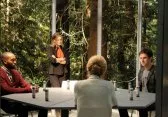
Within the first fifteen minutes of the pilot episode, The Good Doctor introduces us to doctors and administrators from all races and backgrounds. We meet Dr. Andrews and Dr. Melendez, both leaders in the surgery department. There’s also Dr. Browne and Dr. Kalu, both capable residents that train with Shaun once he joins their team. We also have a chance to see Allegra Aoki, the hospital administrator, formally extend the invitation to him as the representative of the board. Each person reveals their own backgrounds and perspectives during their interactions with Shaun. Of course, there is also our brilliant resident to consider - Dr. Murphy is a minority in his own right given his diagnoses and history.
Neil: “All I’m talking about is that we have a patient in this hospital who needs a liver. We also just happen to have a liver that needs a patient.”
Marcus: “It’s not that simple.”
Neil: “It is that simple if you consider the patient. Rules are secondary.”
Marcus: “But is saving this patient worth the risk of not being able to save hundreds of others?”
With so much talk about representation of diverse views in television these days, The Good Doctor really took up the charge with their casting and storylines. We love seeing Hill Harper and Nicholas Gonzalez go toe-to-toe with each other, with Chuku Modu occasionally jumping into the fray. We’re definitely loving the developing friendship between Antonia Thomas and Freddie HIghmore on screen. Through the eyes of these doctors and staff, we’re exposed to the struggles of being part of medicine in this day and age. The show also incorporates common problems like gender bias, funding, and ego into the mix. Every issue is addressed in a realistic and thoughtful manner, giving us a true reflection of being modern healers.
Being someone with both autism and savant syndrome makes Shaun extraordinary…and rare
We are introduced to Shaun, someone who clearly has a hard time communicating with others. He makes little eye contact, doesn’t pay attention to social cues, and says things without filter. However, we also discover that he is highly talented in recalling medical information in great detail. Dr. Glassman argues to the board (and us) that someone with his talents cannot be deprived of a chance to make a difference in the world. We see that firsthand when he saves the life of a young child - twice! After performing a thoracentesis to allow the boy to breathe, he fought for an Echo to be done on his heart.
Aaron: “I met Shaun Murphy when he was 14 years old…He was, and he still is, an extraordinary young man. Yes, he has autism, but he also has savant syndrome genius-level skills in several areas. He has almost perfect recall. He has spatial intelligence. And he sees things and analyzes things in ways that that are just remarkable…Those are assets. Undeniable assets for any doctor, particularly a surgeon.”
Having Shaun be diagnosed with autism is a fantastic way to educate the public on this oft misunderstood disorder. We respect the show (along with its original Korean version) for highlighting the fact that people with mental illness are capable of being productive members of society. However, we also have to point out that the combination of both autism and savant syndrome is extremely rare in reality. Only 10% of those diagnosed with autism have savant syndrome. We understand that having Shaun as a savant is necessary for the show’s premise to work, so we’re going to just leave the statistic here. Either way, we’re super excited to see him succeed and overcome the prejudices of those around him!
When it comes to the actual medicine, it’s both fact and fiction
The surgery department at St. Bonaventure has its fair share of super stars. Between Dr. Marcus Andrews (Hill Harper) and Dr. Melendez, the hospital has quite the reputation. Nonetheless, it is still lacking in private funding and has turmoil between its board members. Real world issues of liability and patient care are at the forefront of every episode. We also see the dynamics between various members of the team, including a few secret relationships and hook-ups. Don’t forget the actual surgeries that keep us on the edge of our seats, or the patient stories that touch our hearts. We get to see everything through the eyes of the people we meet, especially that of our endearing Dr. Murphy.
Unfortunately, as often as The Good Doctor gets real world medicine correct it gets it wrong. As with many medical dramas, they exaggerate the truth or play fast and loose with rules and regulations. We’re not saying that it’s a bad thing - just pointing it out. For example, no hospital would ever allow a surgery resident to schedule and prep for a procedure without attending approval. When Shaun suggests removing the good kidney during tumor removal surgery, not waking up the patient to re-consent is clear malpractice. Don’t get us started on the problems of removing a blood clot from a liver out on a highway. However, this is television, so we take it in with a lot of latitude and enjoy it for what it is - a highly entertaining fictional show.
Final Verdict: The Good Doctor takes care of its audience with solid storytelling and a diverse cast, but could use a little training on medical facts
With ER, MASH, Chicago Hope, and Grey’s Anatomy counted among its predecessors, The Good Doctor had a lot to live up to. Luckily, the show was developed by David Shore, who was involved in the creation of the hit series House, and based on the successful Korean drama Good Doctor. The handling of Shaun’s character as having both autism and savant syndrome has been largely successful. We applaud the casting choices and enjoy the fact that the show doesn’t shy away from true-to-life issues that doctors and hospitals face today. Granted, there are definitely liberties taken for the sake of giving the plot more excitement or entertainment value. However, we understand that this is par for the course. It is, after all, a fictional TV series.
RELATED | STITCHERS SEASON 3 FINAL VERDICT
The writing from David Shore, Bill Rotko, and Thomas L. Moran in these first four episodes has consistently balanced science, drama, and even a little humor. We’re also a huge fan of the sparingly used visual effects that help us to understand what Shaun is thinking. Although all of the actors have been amazing, we have to give a special shout out to the immensely talented Freddie Highmore for his portrayal. We’ve gone through a rollercoaster of emotions every episode, but we’re always left wanting more. The show has us rooting for Shaun to succeed not just at medicine, but also at life. If you’re a fan of medical dramas and want something out of the box, The Good Doctor is definitely worth the watch!

Overall I have to disagree with you a bit on the last part, I dont think its the medical parts that worry me when it’s a drama of this nature, it’s what the drama will be about, yes it’s in the hospital setting so yes medical accuracy is needed in Dr.. Murphy’s portrayal and the cases, but I really hope it’s not a case of being a special case because ABC was “brave” enough to do a drama centered around a doctor with autism, the pilot especially felt cheap in the way it was emotionally manipulating at points. Oterwise it was ok , I agree, it should still be entertainment at its core hopefully. So far it feels like House and McGyver mixed together, but the actors are very good. The writing on this could be better too, like by the title it says “Orville” is also a 4 episode review but Orville is nothing to do with the show so so why is it related, you could link to maybe a video or earlier review? It is just confusing . Sorry this is so long, thanks for rwriting about it.