









A rich diversity in its plot and story ideas regarding the inner workings of the federal government.
Series isn’t re-inventing the wheel which makes it a little too predictable at times.
With Sex, Lies, and Covert Spies Does NBC’s State of Affairs Has What It Takes To Keep Viewers Interested?
It’s been a while since Katherine Heigl graced us with her presence on television, but man does she still know how to make an impression. Although many associate Heigl as Izzie Stevens from Grey’s Anatomy, there’s no doubt she’ll turn some heads with her performance in the political thriller State of Affairs—because when it comes to drama Heigl brings out her “A” Game.
Set in Washington D.C., the series focuses on the political intrigue, and dangers that comes with working for the White House. Producer and creator Alexi Hawley (Body of Proof, Castle) turns his attention to the lives of Washington’s “briefers” whose task is to assemble the book containing the President’s Daily Briefing (PDB)—a collection of information containing “the CIA’s top ten critical threats facing our country.”
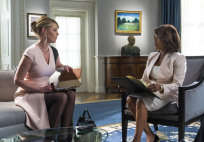
The leading lady at the heart of State of Affairs is Charleston “Charlie” Tucke (Katherine Heigl), a tough as nails CIA analyst who manages the briefers’ information every morning at the wee hours of 2AM for President Constance Payton, played by the amazing Alfre Woodard. Not only is Woodard a phenomenal actress, but having a woman of color as the leader of the free world is damn impressive. Also, the performances between Woodard and Heigl emphasizes their great onscreen chemistry; adding more depth to the connection their characters share. Considering, how very little screen time Constance and Charlie have together, it’s important the right actors are chosen. Let’s just say State of Affairs totally lucked out.
Matters of Life & Death
Whereas some pilot episodes tendency to way a little too long, State of Affairs got to the nit and gritty. Episode director and co-writer, Joe Carnahan, does a great job of setting the atmosphere using some creative shots for the action scenes. The opening sequence of State of Affairs is a perfect example of how Carnahan takes a straightforward and effective approach to immediate problem at hand. Explosions, smoke, and the sound of artillery blast across the screen as we are thrust into a warzone, where a convoy has been hit. The scene cuts quickly to Charlie, and it becomes clear she’s in a therapy session with a therapist recounting an attack that cost the life of her fiancé while they were visiting Kabul. Did I mention her fiancé is Aaron Payon (Mark Tallman), the president’s son? Yes, and so the plot thickens.
Charlie: “Instead of the memory fading over time, it gets more vivid.”
Apparently, not only is Charlie experiencing a form of P.T.S.D., she can’t remember the memories that count, and what she does recall she can’t shake off. Heigl does a great job in the emotional scenes throughout this “Pilot” episode which shows the series’ potential. There’s also some nice character development in the first half of the episode for Charlie, who is going through a wicked streak of booze and one night stands—something she handles without much regret.
No sooner do we see a bit into Charlie’s personal turmoil does the episode transition quickly to the major threats at hand: An American doctor (who eerily looks a lot like her dead fiancé) is kidnapped by an extremist group in Kenya, and on a separate case all together one of the terrorist leaders, Omar Abdul Fatah (Farshad Farahat), responsible for the Aaron’s death in Kabul has been located. The crux of the problem is whether to kill Fatah or let the negotiations to save the doctor held hostage. The Fatah story line has shades of Zero Dark Thirty which is underwhelming at points. As if that wasn’t enough danger with lives at risk, another crisis erupts in the form of a potential CIA information leak by General Abu Sayeed Khan (Farshad Farahat), a Syrian intelligence chief. Seriously, it’s like Murphy’s Law every day in the life of Charlie Tucker.
All of these events boil down to the moment when Constance receives her PDB (presidential daily brief). It’s a race against time, and the last sequence when you see all the briefers work together to help Charlie is a highlight. Without much context to how well each character knows each other, the loyalty she inspires with her co-workers is a reflection of their bond; it’s those tiny moment I enjoy.
Hell Hath No Fury Like A POTUS Scorned
A lot happens in this episode, which isn’t so bad if this took place somewhere in the middle of the season. The main problem with State of Affairs is the way it spreads itself a little too thin. Viewers don’t need to be served a buffet of information, instead we need three solid course meals, so to speak, in order to digest all details. The writers of the episode: Carnahan, Hawley, and Susan Morris have brilliant concepts, but sometimes less is more. State of Affairs already has an interesting angle, and I doubt the general public is aware of all the work that goes into providing the daily briefings for the president, so there’s something new to learn from that topic alone. Why add so many problems at once? The writers have a good start with revealing Charlie’s current dilemmas, and the stress of working with the C.I.A. but sometimes you have to save some ideas for later. Apart from Khan’s story line—which does nothing but add unnecessary drama in already intense episode—the majority of the plot points are valid, but just need to be spaced out more for future episodes. Hopefully, in the proceeding episodes the show will balance the action with some more poignant moments that will allow us to gain a better understanding of the main characters.
Constance: “His death will make killers out of both of us.”
When the last half of State of Affairs winds down, after hard choices are made, the memory of Aaron’s memorial becomes the center of attention. Out of the entire premiere, my favorite moments are the latter half where we hear more from Constance. It’s interesting how the basis of the series revolves around the president’s dialing briefings, but we see so very little of her. It adds an element of mystery; the woman lost her son, and we have not seen any tears shed at all. It’s not until Constance asks Charlie what her plans are with Fatah that it’s clear how these ladies are both coping with Aaron’s passing: “His death will make killers out of both of us.”
Woodard, does a fine job of bringing her best acting chops in the subtle moments where there is no dialogue. She exudes both strength and leadership. The casting is spot on, as is the rest of the ensemble in State of Affairs.
Charlie, You’re in Danger, Girl!
The final sequence in the pilot episode took me by surprise. Aside from hostage rescues, tracking down a terrorist group, and espionage, there is also a matter of plot line involving cryptic text messages being sent to Charlie; messages that suggest she’s got some dark secrets of her own. Although, most of the episode is action driven by crisis after crisis, which in its own way, whether intentional or not, serves as the perfect distraction, Until the very end, we don’t know much about Charlie’s past prior to her engagement. And while the writers may dish out a lot of story lines, they also do know how to set up one doozy of a cliffhanger.
Charlie: “He was killed in a terrorist attack. That’s what happened, and I made it out. And, now I have to deal with it. I have to deal with it everyday from now on and it sucks.”
Queue in Nick Varga (Chris McKenna), a man from Charlie’s profession (and intimate?) past, who breaks into her home and looks like he’s recovering from an attack. Again, could this not have been saved for the second episode? I know it should be a surprise, but the scene is just another thing to add to the list of too much too soon. Apparently what happens in Kabul doesn’t stay there, and Nick re-hashing the events, suggesting there is more than meets the eye with the attack.
Final Thoughts
I love the concept Alex Hawley presents in creating a series where there’s a rich diversity in its plot and story ideas regarding the inner workings of the federal government. There are a lot of nice little touches like the way the musical score by Toby Chu has perfect timing in making some of the more dramatic scenes more nerve-wracking. The production value, and Heigl’s wardrobe alone, is pitch perfect. That said, despite some of the great elements of the show, I still have mix feelings about State of Affairs. On one hand, the series isn’t re-inventing the wheel which makes it a little too predictable at times, but on the other hand the performances are memorable enough to make me watch more.
Currently, there is a large pool of television shows which tackle the complexities of political affairs. What State of Affairs offers as far as intrigue isn’t entirely new, it just focuses on a different part of the political system. What the show needs is its own unique voice. State of Affairs eventually needs to stand apart from other politically driven series, and take the time in developing the core characters while keeping the multiple story lines streamlined. And how does one do that? Limit the action, humanize the characters by demonstrating they are more than their job, make the supporting characters more than sidekicks; give a purpose that is beyond merely a revenge thrill-kill procedural show.
Despite the flaws in the premiere episode, there are elements worth watching like the dynamic between the latest briefer added to the team, Lucas Newsome (Adam Kaufman), who has me suspicious already, and Nick’s backstory which I think will really push forward a lot of the stories set in place. Understandably, the “Pilot” episode is merely a preview for what the series will be about, and if Charlie’s words to Constance are any indication how dark this series will go, then viewers better hold on tight:
Charlie: “Constance, I am going to find every last person who had anything to do with the death of my fiancé and your son, and I’m going to end every single one of their lives.”
Questions, Comments and Concerns
- Am I the only one who thought it’s weird that Nick, not only had to break into her house and take her gun, but that he’s bandaged up? Where the hell did he escape from? Better yet, why does Charlie act like seeing Nick in that condition normal?
- I’m really curious to see more of the people Charlie works with in the C.I.A. when she’s not taking care of the president’s daily briefs.
- It’s fun to think women are often characterized as “emotional” but when you see Constance speak about her dead son at the memorial she is in total president mode with her cool demeanor. It makes me wonder how far and deep she will go to for revenge.

Nice review. I was wondering how this series would fit into the political drama genre. Seems strong women characters are en-vogue these days on those types of shows. That’s a good thing. Time will tell which ones “stick” and which shows fall into the derivative trappings of “like everyone else.”